r/weaving • u/LunarKaleidoscope • Nov 06 '25
Discussion Am I delusional?
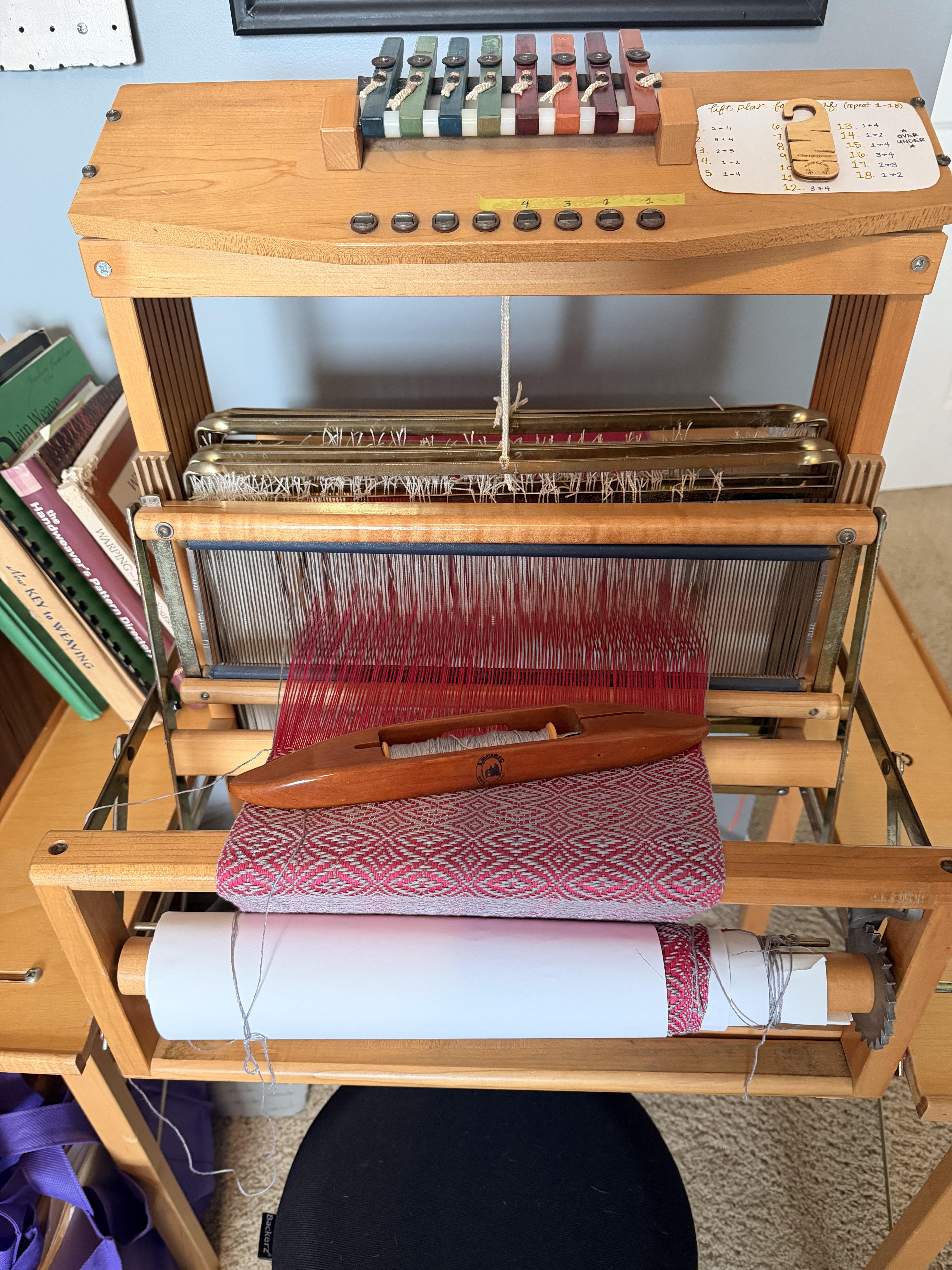
I’m a hand spinner and VERY novice weaver. I don’t know how to sew at all besides doing straight lines with a machine and some basic embroidery…
But I have a dream to start making clothes for myself. Kind of like a capsule wardrobe, but of clothes I made. And I want to spin the yarn. And weave the cloth. And sew them. And decorate it with beads and embroidery. I know clothes have been made this way for millennia, but it seems such a daunting task.
My main question is, is this even worth trying to accomplish with the loom I own? I would have to create strips of yardage, and then probably suture two together along the long sides in order to make it wide enough to use in patterns?
Opinions? Reality checks? Encouragements?
39
u/waywardelf Nov 06 '25
Check out “zero waste” sewing and/or Japanese sewing/garments. Fabric in Japan is often much narrower (14” is common width) so their patterns and garment construction can be geared towards narrow fabric.
6
u/LunarKaleidoscope Nov 06 '25
Thank you!! I’ve also been gravitating towards the idea of a modified Qipao, since the construction of that garment is so simple and beginner friendly.
20
u/mao369 Nov 06 '25
https://www.reddit.com/r/weaving/comments/1eo5r2m/broken_point_twill_dixons_pattern_directory_p86/ 3 panels of cloth. I wear it frequently.
https://www.reddit.com/r/weaving/comments/1dvnmro/102_tencel_warp_202_cotton_weft_daryl_lancaster/ Unfortunately not one I like and wear. The pattern was narrow enough that I did not need to sew it together before cutting it out - you'll learn to look for patterns with narrow pieces.
https://www.reddit.com/r/weaving/comments/r4hsuf/82_cotton_yarn_from_webs_turned_taquet%C3%A9_circles/Here's one that I did have to sew panels together before cutting out the pattern.
https://www.reddit.com/r/weaving/comments/mv39zw/202_cotton_36_epi_4_shaft_table_loom_very_simple/ And this one is sewn together by hand, but the panels were wide enough to *be* the size I needed.
In short, don't worry too much about piecing fabric together. I generally don't do plaids or anything striped widthwise as that might be difficult to match, though you could weave warp based stripes and turn the cloth if you really need to.
2
u/LunarKaleidoscope Nov 06 '25
Wow!!!! Thanks so much for sharing!!! I especially like how on that tank top shirt you joined the fabric on a bias, it makes such an interesting detail!
I feel like when wearing clothes like this, it’s almost like a secret to be shared with other people in this niche interest group. So strange to think that 300 years ago, seeing something so preciously hand made would be commonplace. But now, I would scream OUT LOUD and gush and ask a million questions in a grocery store if I saw someone wearing a piece like that.
6
u/mao369 Nov 06 '25
Oh, the fabric was not joined on the bias, the joined fabric was *cut on the bias*. It's a Darryl Lancaster (darryllancaster.com) pattern called the "900 Bias Top". The fabric was joined at the selvedges.
1
14
u/CluelessSerena Nov 06 '25
It's a big goal but if you enjoy the process and don't mind the effort then go for it
12
u/Administrative_Cow20 Nov 06 '25
I spin and weave, and have done so on and off for twenty years. You can do what you want, but I’d suggest starting small in a way, specifically by using commercial yarns. Go ahead and make some fabric to sew with from commercial yarn and get a feel for what you like (fiber, grist, plies, twist, etc.).
Take notes! Make clothes. Embellish. Start spinning if you haven’t already.
I would suggest an e-spinner for fine plant fibers. I love spinning cotton on my EEW 6.1! (This is assuming you don’t wish to wear wool year-round.)
You may end up wishing for a wider loom, but you can definitely seam panels together, so don’t let that hold you back. Of course you can spin until you have a whole garment quantity of yarn, but I’d suggest using your handspun as weft with a commercial warp to make your handspun go farther. Have fun!
2
u/LunarKaleidoscope Nov 06 '25
Great tips, thank you! And I suppose I will just have to generally practice more. Sewing with commercial fabric some, so I can make a lot of mistakes and learn. Then with handwoven but commercial materials. Then.. the magnum opus lol
3
u/lost-artist--- Nov 07 '25
Yes I second this. Start sewing now with just cotton or whatever to see of you like it and get practice while you are doing the spinning and weaving, so you have a few garments under your belt once you have the cloth made, cause it will take a while to make the cloth. You might get the sewing bug and realize you love it and start making all your own clothes! Or you might realize it's not for you and just stick to spinning and weaving. Either way it's a useful skill, it's always good to learn new things! I love making my own clothes!
12
u/GalianoGirl Nov 06 '25
My grandmother made upholstery for 2 sofas, three large arm chairs, dining room chairs, drapes for 20 feet of floor to ceiling windows on a 36 inch floor loom. Other than the drapes, she spun all the weft yarn, processing raw fleece, dying it etc..
She also made suiting, table runners, placemats, wall hangings, huge hooked and woven rugs. She started weaving in her late 60’s.
I found her notebook. 12 yards for one sofa, 16 for the other, 8 yards each for the chairs.
11
u/ChankleyBore Nov 06 '25
“Sucking at something is the first step to being sorta good at something.” - Jake the Dog. To be fair, that weaving does not look novice! If you have an interest, explore it! If you stick with it, great. If you don’t, you still tried something new.
11
u/Secure_Course_3879 Nov 06 '25
You're not delusional! You're a dreamer :) Head over to r/knitting to commiserate with other delightfully dedicated crafters who have knitted sweaters from yarn they dyed, spun, and sometimes sheared themselves. It may take you a while, but you've got this. You'll discover why fabric was soooooo expensive for most of human history through the process haha
Edit: look at kimono patterns! You might be able to use your fabric to make one. They were originally designed to be constructed from thin widths of fabric
7
7
u/Pyrope2 Nov 07 '25
Check out Sarah Howard https://m.youtube.com/channel/UCEduUEZXBfNee5oB3Fa1ipQ her whole channel is about making clothes using a fairly narrow rigid heddle loom. Good luck!
3
u/Bks4JHB Nov 07 '25
I second Sarah Howard — I’ve bought some of her patterns on Etsy & follow her on Instagram (@getweavingwithsarah).
3
6
u/J_eldora Nov 06 '25
Do it! I don’t know how realistic it is but I have similar goals (though I don’t spin so I plan to buy yarn). Hopefully experienced weavers come along with tips for making clothes with hand woven fabrics.
4
u/Emissary_awen Nov 07 '25
You can do it! I did it! And I didn’t even have a table loom. I spun all my own wool and wove it up on a back-strap loom and made an entire set of robes with my homespun. The maximum width of my cloth was 15” so I basically made a tanmono. To make the clothes i had to go Japanese style and use kimono techniques, but in the end I made a really nice tunic and cloak.
1
3
u/rozerosie Nov 06 '25
I'd say start with building the basic skills across all the areas you'd need to accomplish your idea, and / or integrating two of the crafts at a time (i.e. weave with handspun, sew with handwoven) just to get a sense of what will be required.
Honestly I think the larger limitation than your loom is the sheer volume of time and skill needed - but that might just mean it's a slow project! I finally finished a blanket that I wove from handspun yarn from fleeces I processed just this year, and I started that project many many years ago.
I would say also - make sure you're spending your time on something you enjoy, as well - each stage of the process you're describing is pretty time consuming. It may be worth considering making friends with a sewist and trading them handwovens for some sewing help, if you find that sewing is not your bag!
8
u/LunarKaleidoscope Nov 06 '25
To be honest, I have yet to find a textile based craft that I do not love. I love processing fiber, dying it, spinning it, weaving it, knitting / crocheting it, the small amount of sewing I’ve done has been very rewarding, etc. If anything, this just means I find it difficult to focus on one skill consistently enough to make extreme progress. It’s as if it were a video game, and instead of maxing out “knitting skill” or “sewing skill” and moving on to other skills, I’m putting one or two in each at a time. So I’m relatively competent but not expertly so.
I like to think of it as my insurance plan for the apocalypse. I’m not very fast, or strong, but I can make garments. Theoretically.
6
u/SudsyCole Nov 06 '25
Fellow apocalypse clothing crafter/mender here, LOL - I'm also a "wide not deep" skills person. I love almost every craft I've tried! No reason to specialize 🤷♀️
3
u/Deiaroperi5566 Nov 06 '25
Screw realizism! While yes what you want to do is very ambitious. There is no way you can't do it. I often found I work better doing a big project and learning that way rather then just learning from doing smaller things, so maybe your the same!
4
u/HypnoHaze Nov 06 '25

I’m doing free form on a 4 shaft loom. This is going to be a jacket. The yokes and bottom of sleeve I’m going to use regular fabric.
4
3
u/Proud_End3085 Nov 06 '25
It is a matter of choice of pattern and time to invest in your projects. Good luck
3
u/lost-artist--- Nov 07 '25
This is my goal too! . I want a loom so bad! I already spin, I sew my own clothes, and I learned to weave on a floor loom in college (20 years ago though) I also love using natural dyes to dye my own cloth. I'd say you are already way ahead of me cause you already have the loom and obviously know how to weave! The cloth also looks fine enough weight to make a jacket or something or pants. If I could I would grow the flax or the wool or the silk too (thats not going to happen). I'm going to have to get a rigid heddle loom because of cost and lack of space I my house. I figure maybe I can make fine enough fabric for like a wool coat or pullover or something. I wish I had space for a table or floor loom or that one would just come to me! But I figure I can start with a rigid heddle and upgrade someday when I have more space. There is a lady that makes clothes patterns for handwoven fabric (so narrower width than commercial fabric) on etsy and I can't remember her name, so people do it. I'd say go for it! The year it takes to make one garment will be worth it I think, I'm not being sarcastic. I'm definitely hoping to get there in the next year or so.
3
u/lost-artist--- Nov 07 '25
Also if the sewing is intimidating to you, I think you can learn it. All these fiber arts go hand I hand. I've been sewing for 20 years, that was my first fiber arts love that got me into the rest of it. If you have what it takes to learn to weave and handspin, you can sew too if you just practice, it's just a step by step kind of thing. Choose and easy or uncomplicated pattern and make a mock up out of cheap cloth before you cut into your precious handspun cloth!
3
u/Apprehensive_Pen69 Nov 07 '25
Humans have pieced fabric together to create larger pieces for centuries and longer! Even for those fancy ballgowns you see in museums. Your loom and skills are definitely up to the task. I believe in you ☺️
You can also look into double weaving, where you weave double the width of cloth on a loom (so a 30" inch piece on a 15" loom!) if you really don't want to piece panels together! Its a simple concept but I'm afraid it is a little too close to midnight for me to explain at the moment 😅
3
u/darklyndsea Nov 07 '25
Another one for the "that's my goal too" crew.
As the historical costumers are fond of saying, "piecing is period." Various cultures in various time periods used various widths of looms, and all of them managed to make beautiful clothing that fit actual human beings. Modern designers use smaller pieces of fabric for style reasons (e.g. color block)—the basic process isn't too difficult, but if you're a beginner at sewing it's probably something you'd want to wait for later before exploring.
Important to the process of making your own clothes completely from scratch will be tight control of the thread you spin, and (depending, of course, on the kind of clothes you want to make) probably spinning finer thread than you have before and weaving at higher sett. I haven't done either, but I'm sure each has its challenges.
3
Nov 07 '25
F reality check and f managing expectations. I say go for it! Pedal to the metal and no speed checks!
I say watch shows like the great British sewing bee to get inspired by home sewers. Also A Stitch in Time (show not movie) which goes through recreating historical fashions that served as a fulcrum during pivotal moments in history. What I think will be useful from a stitch in time is how you lay out patterns on thinner strips of fabric, bc like you said, people have been using fabric from home looms for most of human history. Oh, and also Tudor Monastery Farm where they go over the shearing to weaving of fabric. That will be great inspiration 🙌
1
3
u/warrior_female Nov 07 '25
ppl pieced together clothing from narrow strips until the 1950s or so when looms became wider, before that the widest apparel cloth was like 45"
3
u/Woodsy-Fox Nov 08 '25
If that is your work on the loom, you are fully capable of achieving such a goal. And, it's an awesome project! Stepping up the width of your loom would make things go faster, but decide exactly what the parameters of your process and technique will most please you.
I have a dear friend who only makes wearables from her own animals, sheared by her, fiber processed by her, spun and dyed with natural dyes. It's a unique and very fulfilling niche that she enjoys. Her joy and the quality of the process shine through.
All this is about you, your vision and what brings you joy. I think it would be an amazing craft accomplishment. No matter what you decide, it is perfect if it pleases you.
I hope you share your projects, this is an awesome path!
3
2
u/msnide14 Nov 06 '25
You’re not delusional. I am a poor seamstress and a mediocre weaver and I have made very passable things. You can make wonderful things, I’m sure.
2
u/barnloom Nov 07 '25
Hello, check out Old School Wool and Weaving Center - The Journey on FB if you are on it. Or, Old School Handwovens on IG. You are certainly NOT alone. I have a school dedicated to doing just that, only as it was done, ( mostly as it was done with a few modifications ) in the 18th century using the tools from that period. Spinning wheels, looms and 19th-20th century foot powered looms. Absolutely follow you vision, and I will help you if I can! While it does seem overwhelming, it's much less so if you do it alongside others who are learning as you are. I'm thinking in a class. Practice your hand sewing skills if you aren't already well schooled in those, in the meantime. They are invaluable even when you have access to a machine. Best of luck!
1
2
u/Ill_Musician3284 Nov 07 '25
Look for Max Tilke's Costume books. Line drawings and watercolors of garments sewn from narrow fabric. He was a mid 19th century Gentleman Anthropologist who traveled the world documenting and drawing the clothing worn by indigenous and tribal people all over Asia, Central Asia, North Africa and the Mediterranean. Dorothy Burnham's Cut My Cote is a short version of Max Tilke's books
2
u/Badfaerie Nov 07 '25
You have plenty of room to grow with this loom without resorting to sewing narrow strips together. I suspect that you have a 15” weaving width (40 cms is a little wider, but 15” is close enough) and 8 shafts. This means with doubleweave, you can weave 4 shaft patterns up to 30” wide on the loom and 2 shaft patterns up to 60” wide. You will lose some width in the final cloth to draw in and such, but that is workable widths for yardage.
Now, double and quadruple weave is brain bending and takes 2 to 4 times longer than weaving the same cloth on an appropriately sized loom, but it is doable. A side benefit is you gain a deep understanding of how the cloth structure and the loom mechanics interact.
You got this!
2
u/Superb_Piano_3775 Nov 08 '25
I'm currently working on a wool cloak for myself. You should be able to do anything you set your mind to.
2
u/existentialfeckery Nov 08 '25
You got this. It's possible and it's so rewarding and fun.
I started weaving ten years ago and spinning 8 years ago and it's still one of my most rewarding hobbies.
I started a dye garden too now so some of my projects can take 2-3 years to complete ❤️
2
u/elstamey Nov 08 '25
I believe Sarah Howard has a few sewing patterns that focus on using smaller pieces of handwoven. It'll be a good place to start while you get more weaving experience. Then, you can learn Doubleweave, which would give a decently wide strip of fabric for sewing. And I believe the larger loom will come your way, especially if you are involved in guilds of weavers or spinners.
2
u/lankira Nov 13 '25
I currently do everything you mentioned except weave (I'm getting a loom later this month!), and I think it's a grand idea.
There will be hurdles and stumbling blocks, but it's doable! A costumer on YouTube that I follow (Bella Maes Designs) dyed the yarn, wove the fabric, and sewed a costume from The Chronicles of Narnia as her first weaving project.
You have a head start by comparison. All you need is a needle and thread.
1
u/wright1965 Nov 13 '25
I'm near Sacramento and DM me if you'd like. I've successfully made a top and interested!
0
115
u/bondagenurse Nov 06 '25
Why not? The worst you can do is fail, which you will, because we all do! Failing is temporary. The part that makes it worth it is when you dust yourself off, climb back on the horse, and try again. Because eventually you will succeed, and the pride and happiness that will come from wearing a garment that you made every single inch of will be astronomical. When the going gets tough, imagine you walking out of your house proudly wearing clothing that you made whole cloth. You can do this.
You say you're a "novice" weaver? I call bull. You're doing amazing work. Your selveges are INSANE for a "beginner". You successfully threaded an eight-shaft loom! Damn. Give yourself some credit for being amazing. I'm looking forward to seeing your future posts about the awesome things you create.
[Also, I've found that new looms tend to manifest in the strangest of ways. A bigger/more complex one will surface for you. It's the Loom Distribution System.]