r/ECE • u/throwaway8490247 • 3d ago
HOMEWORK (GOOD) Help with Thevenin equivalent circuits
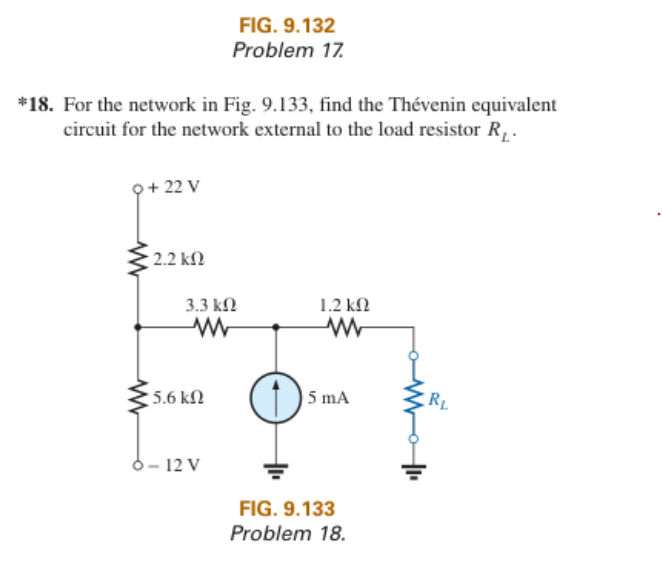
In advance, I appreciate the help. I know this sub has a "do your own homework" attitude, but I've been staring at this problem for hours and can't figure out how to proceed. I understand TEC circuits pretty well, and had minimal issues with every other problem, but this specific one has stumped me. I've reread my chapter and watched TEC lessons on Youtube, but can't find anything that fits this specific example.
I've got half of this solved. Finding the Thevenin Resistance is simple enough, I shorted the Voltage Sources and opened the Current Source. 1200 +3300 + ((2200*5600)/(2200+5600)) is ~6080 ohms.
Where I'm running into an issue is finding the Thevenin Voltage. If the Load Resistor is opened, then it seems to me that the entire circuit is open. If the circuit is open, then the current source has nowhere to flow, and I can't find the solution. I would convert the current source to a voltage source if I could, but I don't think that can be done, because there is no parallel resistor.
The best solution I've come up with is to find the voltage at the junction between the two voltage sources and their resistors, while treating the current source as non existent because it doesn't have anywhere to flow to. However when testing this result (12.41 V) in a simulator it doesn't seem to work. What am I doing wrong?
Edit: Solved, Thank you everyone for your help. If anyone is having trouble with a problem like this themselves, I worked it out and posted the steps in the comments below.
18
u/South-Mine7572 3d ago
If the load is open then all the current will flow through the 3.3k resistor find the voltage at the tip of the current source and since the 1.2k resistor is connected to open circuit and no current is flowing the voltage difference across it is zero meaning it has the same voltage on both terminals (the voltage of the other terminal of the current source) A KCL equation and KVL equation and your circuit is solved