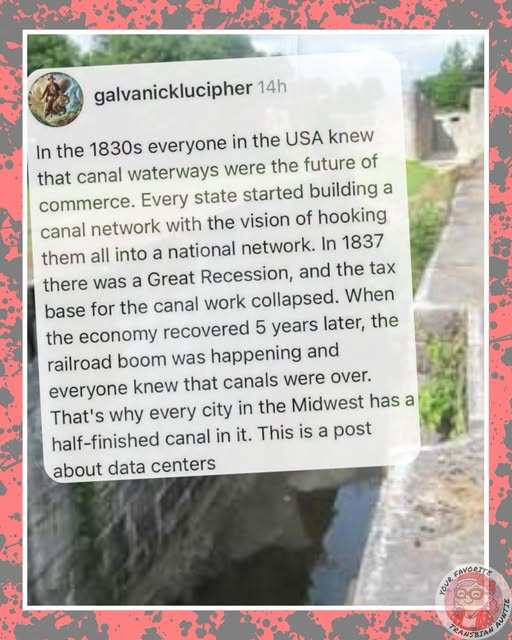
And then the railroad industry crashed and we got stuck with cars/highways at the default mode of transportation for everything because it's cheap, easy to maintain, and owned by the state despite being objectively less efficient for mass transportation of goods and people as a railroad is.
Panic of 1873. There was "over speculation" within the market, which is a common trend throughout US economics and it basically means companies found a loop hole to generate profit/revenue through speculation rather than active income from a provided service/good.
Railroad companies were booming in terms of speculative profits, so people kept investing into railroad companies as long as they looked profitable on paper. So railroad companies did the most obvious thing, and built railroad tracks in the cheapest ways possible, which sometimes would end up being places that go nowhere at all. Why? Because companies weren't looking at their profits, they were looking at their total capital value. They had tons of railroads and were expanding, so they must be a good investment, so you invest, company builds more railroads, that impresses investors, yada yada.
It collapsed when the railroad companies ended having to actually justify continued investment, and they didn't have the profits to do so, so people stopped investing and railroad companies went bankrupt, shrank, or stopped growing.
Sure it crashed but "default mode of transportation"? Does the freight network of the U.S. not contribute to the economic movement between states? Ugh I'll look it up. Basic google search:
If time isn't a problem then freight trains are roughly 3 to 5 times cheaper than semi-trucks on a pure distance-and-weight basis. Not being affected by traffic and weather as much. Overall the last mile problem still exists between the two.
But I think at this point we've digressed from the topic. "Still relevant" is different from the boom/bust cycle discussion. Which is how canal vs rail different slightly imo
Sure but if you have a product that you know sells 5 tons of every month it can be delivered to the area reliably. This is a lot of things that aren't niche, especially any raw goods fall under this bracket. Main issue would be around perishables
IIRC USA has the largest train network in the world if you include freight lines, which IMO makes it more unfortunate because countries like China have much smaller freight systems while still moving about 8% of their internal tonnage through their freight systems. All the while the US has virtually 0 passenger rail
I'm awful sorry, but economic historian over here. And your timeline doesn't really jive.
In 1873, there was approximately 70,000 rail miles in the US. In 1914, there was approximately 250,000.
Railroads tended to grow until they saturated an environment. The US was nowhere near that number in 1873. Heck, the frontier was still open at that point and I think there were only two transcontinental railroads. (Out of the total that five would be built, four in the US and one in Canada.)
The panic of 1873 was primarily caused by Gould and other robber barons. Yes, they were invested in railroads, but it was the corrupt behavior that caused it, along with some coinage stuff.
However, the 1840s Railway Mania in Britain looks a lot closer to the model that you talk about. That was a right old mess with way too much investment. Frankly insane levels of investment. No one ever had the profits of the first years of the Liverpool Manchester. And they were never going to. Shockingly enough, the first railroad built was the most profitable railroad. Built in the most industrialized part of the world at that time.
Jay Cooke & Company Collapse: The major banking firm ran out of liquid capital while trying to finance the Northern Pacific Railway, forcing its bankruptcy on September 18, 1873
Rapid, debt-fueled construction of railroads following the Civil War vastly outpaced actual economic demand
"Between 1866 and 1873, 35,000 miles of new track were laid across the country"
resulting in a total of 70k by 1873
"Banks and other industries were putting their money in railroads. So when the banking firm of Jay Cooke and Company, a firm heavily invested in railroad construction, closed its doors on September 18, 1873, a major economic panic swept the nation."
Bankruptcy DIRECTLY tied to over speculation on the railroad industry
"Mirroring the firm's collapse, many other banking firms and industries did the same. This collapse was disastrous for the nation's economy. A startling 89 of the country's 364 railroads crashed into bankruptcy."
24.4% of all railroad companies went out of business
"That same year, the depression set off railroad strikes. Workers all over the country, in response to wage cuts and poor working conditions, struck and prevented trains from moving. President Rutherford B. Hayes was forced to send federal troops to more than a half dozen states to stop the strikes. In the end, the fighting between strikers and troops left more than 100 people dead and many more injured."
This isn't really a "We're open for suggestions" type of scenario. The cause is incredibly well understood and documented. The primary driver of the panic of 1873 was the railroad crash, end of story. That's not a "Oh we aren't sure" situation, no we're sure. That's exactly what drove the panic of 1873.
There are some inconsistencies in your argument. Perhaps you should consider that you might be mistaken.
Trains
do not cause problems. Railways do not cause problems. Infrastructure generally does not cause problems. Perhaps more saliently, 73,000 miles of rail in 1863 vs 160,000 today or 250,000 in 1914 is not overbuilding. High quality roads did not exist until the 1920s anywhere in the world outside of a few miles of brick pavement in a few inner cities. In 1873, transportation more or less relied exclusively on water-based transportation, or increasingly, railroads.
Every
little town had to have their railroad/tramway. Railways were one of two low cost transportation technology available to them. In the case of large parts of the United States where canals were not feasible, the only technology. If you wanted to visit your aunt in the next town, you needed a railroad. If you wanted to get goods from Marshall Fields, you needed a railroad. If you wanted to sell your grain in Chicago, you needed a railroad. You could use oxen for maybe a dozen miles or so to haul it, but then you needed to put it on rails. The cost of transportation off of railroads was entirely too high.
It was not even the transcontinental railroads that caused the problems. Once it was completed about a decade later, the Great Northern was a valuable railroad. Clearly the production of the Great Northern was not the problem. The actual railways were not the problem, nor were railways/tramways significantly overproduced for the 1873 technology environment.
So if it was not overproduction of railroads, what was the problem?
Humans cause problems. In this case, it was investments, combined with deflation from the abandonment of the silver standard. Men like Gould and Cooke were extremely corrupt. The Crédit Mobilier scandal had broken out the year earlier. Reports from firms could not be trusted. Government oversight could not be trusted. By 1873, the confidence damage was completely systemic. Money could not be moved confidently into businesses nor banks, nor, as a result of the coinage act of 1873, even specie. It was a right mess.
When the Northern Pacific could not get its bonds sold, it wasn't the railroad that was the problem. It was the bond sales. It was the trust in the market. It was the bank failures. It was the systemic corruption of both government and industry. The railway was still profitable, the firms were not. The firms were not profitable because the men who ran them were corrupt. The men who ran the firms were corrupt because government allowed / encouraged it.
If a person cannot trust finance mechanisms, they cannot trust investments and money. The cost of risk becomes too high. This has multiple knock-on effects but essentially results in economic depression.
Going back to your argument directly. You are trying to shoehorn this into a data center analogy. But perhaps you should be considering rather than the actual data center construction, the cost of the Trump administration corruption. Relative to railway construction, data centers and hardware are transitory. But the failure of a bank due to corruption is the same today as it was in 1873.
I'm not "arguing" this. Notice how I'm the only one who actually cited a source while you're talking on about your own personal theories. You can hold whatever beliefs you want, but I'm gonna trust literally everyone else and their take on it because they seem to agree whereas you have a unique take that isn't backed by historical evidence.
71
u/imnota4 19d ago
And then the railroad industry crashed and we got stuck with cars/highways at the default mode of transportation for everything because it's cheap, easy to maintain, and owned by the state despite being objectively less efficient for mass transportation of goods and people as a railroad is.