r/Nietzsche • u/cronenber9 Deleuzian • 1d ago
Post-structuralist thought seems far more to be the legacy of Nietzsche than right wingers like BAP
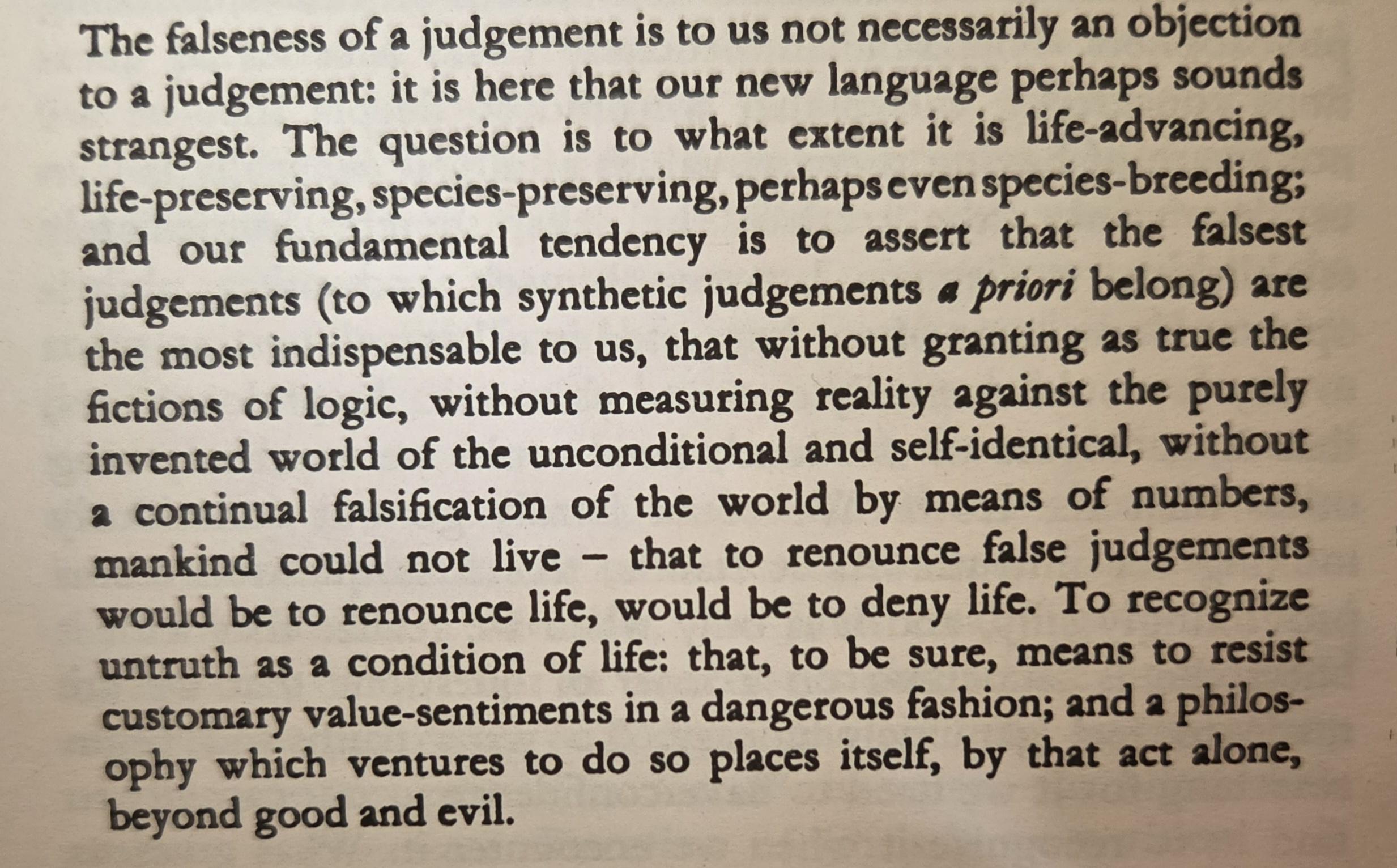
I suppose I do understand how they might see their traditionalist values as social constructs necessary for the preservation and flourishing of life, but doesn't seeing life is primarily biological seem like a very surface level reading of Nietzsche? I think this passage is reflected in a much richer way in Deleuze's definition of philosophy as the construction of new concepts, and in his ontology as the return and differentiation of active forces. Post-structuralist theory and, to a degree, critical theory, is the legacy of Nietzsche, which makes this century a Nietzschean century. BAP is the legacy of Elisabeth Förster.
2
u/anycoluryoulike1 1d ago
Elisabeth neutered Nietzsche. Nietzsche is not a traditionalist. But his emancipatory zeal is not about equal rights for all, quite the opposite. He wants to emancipate a small term of Olympian men from the shackles of abrahamic slave morality. The good Europeans, lords of the earth, etc. all point to the same thing he desires: an elite pan-European ruling caste that is pro-aristocracy and pro-imperialism, and against equality and the various iterations of the egalitarian project.
“The rights which a man arrogates to himself are relative to the duties which he sets himself, and to the tasks which he feels capable of performing. The great majority of men have no right to life, and are only a misfortune to their higher fellows. I do not even give the deformed the right. There are deformed peoples too.”
The italicized lines were removed by Elizabeth btw.
5
u/sudo_i_u_toor 1d ago
Post-structuralist theory, critical theory and so on, despite being without a doubt influenced by Nietzsche, are the very opposite of Nietzschean, since they are founded on the ressentiment of the downtrodden and deconstruction. Deconstruction is what Nietzsche is talking about here, really. So, say, you make an argument that there's no such thing as race, that it's socially constructed. So far so good. But what you are rooting for is that therefore it's false and "therefore" racism is irrational and we need to be hecking wholesome chunguses who love their neighbor. But Nietzsche says go ahead and hate your neighbor for a made up reason. You know why? Because in Nietzsche's and post-structuralist metaphysics alike there's no you and there's no your neighbor. To live is already to engage in "falsehood" automatically, such as that you today and you yesterday are the same person. You make yourself up. This creates the "illusion" of "ego" and so all conflict, hatred and so on. The only thing that Nietzsche does here which is different from Eastern pessimism and modern wokism is saying splendid! Let there be samsara!
6
u/diskkddo 21h ago
That's not at all what any post structuralist is arguing. Complete strawman. Hence why Chomsky (not a post-structuralist) called Foucault (a post-structuralist) the most amoral person he had ever met (Nietzscheans rejoice!)
Also, you might be interested in the East-Asian Buddhist idea that 'samsara is nirvana'
1
u/cronenber9 Deleuzian 14h ago
He definitely believes that. He thinks escaping Samsara is bad.
1
u/sudo_i_u_toor 13h ago
Who "he"?
1
u/cronenber9 Deleuzian 13h ago
sudo_i_u_toor
1
u/sudo_i_u_toor 12h ago
Lol. I don't think it's bad, I think, as far as this metaphor is applicable to Nietzsche, it's impossible in the first place and it's a good thing that it's impossible (I am not saying that it's a good thing because I think it's possible for it to be possible, it's a contradiction in terms; I am saying it's good because that's the natural reaction of anyone who says yes to life). In Nietzsche terminology, it's not called escaping, but called life denying. The key insight of Nietzsche is that it's rooted in ressentiment, not in any noble enlightened altruistic or "rational" impulses, and furthermore precisely because it's rooted in such an "afflictive" emotion, it won't get you very far, even by the ascetics' own logic. The world is will to power and nothing besides. There's, consequently, no escape from the will and the will (which is just tanha writ large and applied outside of the psychology of sentient creatures as well, while in Buddhist it's only limited to them) is all.
1
u/cronenber9 Deleuzian 12h ago edited 12h ago
If Nirvana was actually real then I'm not sure how achieving it would be rooted in ressentiment. Wouldn't it be motivated by the search for truth and by the realization that, ultimately, the world is an illusion? At least I'm guessing. I haven't studied Buddhism.
1
u/sudo_i_u_toor 12h ago
Bruh with all due respect, have you read Nietzsche? I have no doubt you read a bunch of psychoanalysts and post-structuralists, but have you read Nietzsche? Search for truth? Have you read what Nietzsche wrote about will to truth and its underlying motivation?
I think even the "just leave me in peace" defeatist spoiled egalitarian impulse is rooted in ressentiment. Who says "I don't want war, I want peace"? A loser. Who wants to drag everybody down on his level.
Nietzsche didn't think this sort of more honest pessimistic ascetism was motivated by ressentiment. He thought it strives to overcome ressentiment, yeah, but it's only in this case life denial is genuinely rooted into declining vitality, while ressentiment in the Christian vindictive sense is in fact an expression of an excess of frustrated will to power, so to speak, so plenty of vitality there.
In PRACTICE from my observation, genuine pessimsitic ascetics are thankfully very rare. I mean they are just mentally ill, we nowadays recognize their behaviors in the DSM. The majority of proponents of ascetic religions are religious bigots who are actually motivated by ressentiment. Where I disagree with Nietzsche is that these religious bigots are somehow "worse" and more importantly that there's always a clear line to draw.
Go to some far left subreddit and you will see a lot of people with all sorts of self-destructive masochistic tendencies, escapist, even suicidal tendencies, who root for antinatalism, who hate the self and prostrate themselves before the other and so on and yet are more moralistic and vindictive than the most bigoted of Christians. So yeah, these things are way more intertwined and I haven't really thought it all out well.
1
u/cronenber9 Deleuzian 11h ago
Nietzsche didn't think this sort of more honest pessimistic ascetism was motivated by ressentiment.
Welp.
1
u/sudo_i_u_toor 11h ago
What? You think it's a gotcha because you think metaphorical usage of Buddhist concepts must always fall in line with actual Buddhism lol?
Here's Nietzsche's usage of nirvana in the same way I use samsara:
“Pity preserves things that are ripe for decline, it defends things that have been disowned and condemned by life, and it gives a depressive and questionable character to life itself by keeping alive an abundance of failures of every type. People have dared to call pity a virtue… people have gone even further, making it into the virtue, the foundation and source of all virtues, - but of course you always have to keep in mind that this was the perspective of a nihilistic philosophy that inscribed the negation of life on its shield. Schopenhauer was right here: pity negates life, it makes life worthy of negation, - pity is the practice of nihilism. Once more: this depressive and contagious instinct runs counter to the instincts that preserve and enhance the value of life: by multiplying misery just as much as by conserving everything miserable, pity is one of the main tools used to increase decadence - pity wins people over to nothingness! … You do not say ‘nothingness’ : instead you say ‘the beyond’; or ‘God’; or ‘the true life’; or nirvana, salvation, blessedness … This innocent rhetoric from the realm of religious-moral idiosyncrasy suddenly appears much less innocent when you see precisely which tendencies are wrapped up inside these sublime words: tendencies hostile to life.”
Obviously to Buddhists nirvana is not the same thing as "God" but both have in common denying this world for something else. The world is an illusion is also a mindset of post-structuralists with all their constructivism and deconstruction is the conceptually equivalent (metaphorically, not literally, I am not saying they are meditating under a tree) to "escaping the world of illusion/samsara". Now in the case of post-structuralists it's motivated by the desire to hurt and rebel against the prevailing order. In Buddhism there's no such desire, and so, yes, literal Buddhist monks are rarely motivated by ressentiment, while Western equivalent of escaping from samsara almost always is.
→ More replies (0)1
u/sudo_i_u_toor 13h ago
Also, you might be interested in the East-Asian Buddhist idea that 'samsara is nirvana'
It's an exaggeration of a misunderstood passage in Nagarjuna. His point was that even samsara and nirvana don't have truly independent existence, not that De Sade was as enlightened as Siddharta
5
u/cronenber9 Deleuzian 1d ago
Oh it's you again lol. No, they aren't based on ressentiment. I can see that point maybe being made about some of the worst critical theory, in fact I agree with it, but not Post-structuralist theory and certainly not deconstruction, in fact that makes zero sense. I think people like to talk about theory they haven't studied enough to know much about. The least Nietzschean aspects of Derrida are because of his phenomenological basis, not anything to do with ressentiment.
I don't think you could articulate whatsoever how deconstruction is ressentiment because it really makes no sense. It's an anti-platonist way of reading a text. And as far as claims that race or gender are socially constructed, most critical theory is not saying that we should therefore not have gender or race. I think people should probably read the stuff they're critiquing 😭
Ironically, your point about the ego is highly Deleuzian.
5
u/sudo_i_u_toor 1d ago
Deleuze's great contribution to the study of Nietzsche was his ideas of negative nihilism and reactive nihilism. They are clearly present in Nietzsche already, in latent form, but he never came up with a way to contrast them. Platonism is a form of negative nihilism. Denying the world for... another world. Contrary to the popular opinion, Nietzsche's attitude towards this form of nihilism was ambivalent. Hell, in the passage in your OP he's almost defending it. There may not be Platonic immaterial "number" in itself floating out there, but it's sure as hell convenient to assume there is. You have to make these false assumptions to live. I go further than Nietzsche, I say that if we take his anti-metaphysics seriously, then we already live in a false world of being by default, the hinterwelt. The "real" world is the world of becoming but we don't experience the world that way. You can read about how eye sight works, for example, there was a guy who a got a surgery and gained eyesight for the first time when he was already an adult. All he saw was a bunch of amorphous colors and he struggled to recognize even basic objects. Why? Because objects are not "there" in the raw sense data, they are an interpretation of this sense data. They are the false world of being superimposed over the world of becoming (raw sense data) and that's the world we live in. Already.
Nietzsche's true enemy was reactive nihilism. It was nihilism of Schopenhauer and the like. He tended to interpret Christianity in a Schopenhauerian way. Schopenhauer was an atheist, he didn't believe in heaven and all that. For him it was a mere metaphor, a lie, to represent a hidden truth. What truth? The absolute of reactive nihilism, which is not the world of being, but nothingness. Nietzsche just does a cheap trick here. If there are no Platonic objects, then hinterwelt of negative nihilism is also nothingness. But it's not, there's a difference between a non-existent concept and the concept of non-existence, and he himself realizes it from time to time, like in the passage from your OP, which is one of my favorite passages and is a more philosophical elaboration on having art not to die of truth as he puts it. To live is to affirm and make use of illusions.
2
u/cronenber9 Deleuzian 1d ago
I love how you sound so incredibly Deleuzian while trying to say that Post-structuralism isn't the legacy of Nietzsche though. I have nothing to disagree with here.
1
u/sudo_i_u_toor 1d ago
Post-structuralism is the legacy of Nietzsche in the same way Marxism is the legacy of Hegel. On the one hand yes it totally is, on the other hand only the relation is a bit like the Catholic mass and a hypothetical black mass.
But yes, perspectivism, power dynamics, the critique of the dialectic, deconstruction of the subject and so on are something important they have in common. It's just that... what you do with all this matters.
1
u/cronenber9 Deleuzian 1d ago
I mean Marxism is highly informed by Hegel and the only reason dialectics lived on past Hegel, so... yes. It's just that saying BAP is the legacy of Nietzsche is more like saying nazi Germany is Hegel's legacy. Which some have literally claimed.
2
u/sudo_i_u_toor 1d ago
I mean Karl Popper thought Plato was basically the first fascist. People will have all sorts of wild takes with different degrees of truth to it. There's a great degree of truth to your take that post-structuralism is Nietzschean and my intention is not so much to refute it as to complete it by highlighting in what ways post-structuralism is not Nietzschean. Marxism inverted Hegel's idealism. Nietzsche inverted Schopenhauer's pessimism. Post structuralism likewise inverted Nietzsche's value system
2
u/cronenber9 Deleuzian 1d ago
I know. These people are genuinely insane. But I do think that "degrees of truth" are the best we can do. It's all about what it's in the service of, as you pointed out. What is it that you're trying to construct or destroy?
I would see it as Marx recontextualized Hegel within a materialist and political theoretical and social system, inverting it is a dialectical way of thinking about it. I don't think it was an antithesis because I don't agree with Hegel. It was a move that took aspects of Hegel and recontextualized them. Of course things were changed in the process, I just think inversion is a holistic or general view that takes the totality of a system of thought and then inverts it within a dialectical, teleological structure. I don't think Marx, or anyone, really did that. So the Post-structuralist employment of Nietzsche wouldn't be so much an inversion as a recontextualization of Nietzsche, using some of his theory like a hammer; a tool within the critique of postmodernity, new social and material conditions that didn't exist during Nietzsche's life, but for which his theory was uniquely suited to critique because he was "out of time".
But I totally agree with your point that they didn't simply take Nietzsche wholesale and repeat his words. They used his principles and concepts within new theoretical systems that they, themselves, were constructing. And i think it's largely positive that they constructed a Nietzschean left (or kind of left-ism) as an alternative to the Marxist/Hegelian thought that dominated the left m
2
u/sudo_i_u_toor 1d ago
An inverted philosophy as a rule is much closer to the philosophy that it inverts than a random unrelated philosophy, just like how -1 and 1 have more in common than 1 and -sqrt(20)*pi. Opposites are closer than unrelated things. Hate is much more like love than sewing machine is like an umbrella.
I used to think that Nietzsche, being an aphorist, himself was all for using his work as a hammer (I mean he liked to philosophize with it!) like you said. Emil Cioran, himself an aphorist, made this point about him:
Nothing is more irritating than those works which “coordinate” the luxuriant products of a mind that has focused on just about everything except a system. What is the use of giving a so-called coherence to Nietzsche’s ideas, for example, on the pretext that they revolve around a central motif? Nietzsche is a sum of attitudes, and it only diminishes him to comb his work for a will to order, a thirst for unity. A captive of his moods, he has recorded their variations. His philosophy, a meditation on his whims, is mistakenly searched by the scholars for the constants it rejects.
But then I realized Nietzsche himself wasn't a fan of this approach:
The Worst Readers.—The worst readers are those who act like plundering soldiers. They take out some things that they might use, cover the rest with filth and confusion, and blaspheme about the whole.
I have to admit that I do read like a "plundering soldier" as there are very few works of philosophy that I can wholeheartedly agree with and Nietzsche is certainly not among them. My way of reading most philosophers is absolutely irreverent. I acknowledge the genius of Nietzsche, for example, but I won't pretend that he wasn't basically a loser ("but he was a professor" so?). I think a good deal of post-structuralism is outright word salad, and some of it is downright vile, but it doesn't prevent me from loosely borrowing their ideas as well. So you say I sound kinda Deleuzian here, which I do on purposes. Do I personally subscribe to this anatta/bundle theory of self/"impersonalism", etc.? No, in fact I fucking loathe it lmao, as you know. But I think about it. And what I think about it is that even if it was true, a self must be invented (kinda like Voltaire about God?). Nietzsche himself is particularly interesting in this regard as he sits on a tension between his metaphysics and his value system here.
It's not about ideas. It's about what you put them in service of. Ted Kaczynski put Nietzsche-like ideas in service of radical ludditism and Nick Land put Nietzsche's ideas in service of technocapitalist accelerationism.
1
u/cronenber9 Deleuzian 1d ago
I wouldn't say any of these things are opposites. Not Marx and Hegel nor Deleuze and Nietzsche. Again, this is a dialectical perspective because it uses the position of identity. A deleuzian perspective here would say that Marx's theory is like a filter that mutates some aspects of Hegel in recontextualizing it. As opposed to being the mirror opposite of Hegel as a whole. Gay is the opposite of straight on the level of identity and general concept. On the level of difference, these are just slightly different behaviors. Hate is closer to love because they are mutated forms of one another, differentiated on a flat plane.
I don't think Post-structuralist theory is word salad, but it is purposely obscure. It makes sense, but only if you put the effort into trying to understand it. And I don't think that's necessary, philosophy should actually be accessible and written for clarity, but this was the way theory was written in France at the time. On the other hand, anything is inaccessible if you don't have the vocabulary and context, so you do have to kind of specialize in the area in order to understand it, just like not everyone can pick up a book on highly specialized math and know what's going on. There is technical language being used.
→ More replies (0)1
u/sudo_i_u_toor 1d ago
and as far as claims that race or gender are socially constructed, most critical theory is not saying that we should therefore not have gender or race.
Let's take a very common sentiment in these circles, hard to argue with: "Gender roles are oppressive"
This sentiment is founded on ressentiment ("I am being oppressed! These birds of prey really hate us lambs! They abuse us with their patriarchy. We are oppressed innocent victims and they are evil oppressors" c'mon). It's also founded on the will to truth, i.e. gender roles are made up, they are a scam, you think women are like this and man are like that? But in reality it's made up and enforced by power. Now ressentiment + will to truth lead to one conclusion. Abolish gender roles. As a form of liberation.
Very straightforward stuff.
3
u/cronenber9 Deleuzian 1d ago
Right, and I don't necessarily disagree. Even in my original post I said some critical theory. Some of it is very much what you're saying. But really, the best critical theory is only pointing out the construction of gender roles, the stuff closer to Foucault and his genealogical method, which is heavily informed by Nietzsche's genealogy of morals; that is, showing the constructed nature of morality or gender, not making moral and value statements about it.
And one can also engage in an active project coming from things like this. For instance, attempting to abolish gender is not the same thing as whining about being oppressed by it. It's an attempt to create an alternate set of social norms (not saying I think that's what should happen, I'm just pointing out the difference).
0
u/sudo_i_u_toor 1d ago edited 1d ago
that is, showing the constructed nature of morality or gender, not making moral and value statements about it.
Nietzsche would ask "why show the constructed nature of morality or gender" in the first place. You see, it's all about psychological motives. If the motive is weakness and sympathy for weakness and so ressentiment, then even if you don't make overt moral statements about it, your work will still reflect the values of slave morality. What do you think Nietzsche would think of radical feminism and the like? Here's a hint:
- When a woman has scholarly inclinations there is generally something wrong with her sexual nature. Barrenness itself conduces to a certain virility of taste; man, indeed, if I may say so, is "the barren animal."
There's no unbiased "showing of the true nature of the world" as per Nietzsche. A value system is implicit in any interpretation soever, even if no calls to action are involved. So to say "men are patriarchal rapist pigs and women are enslaved by capitalism" (yeah this is a caricature/strawman, it's a mere illustration) is already a manifestation of decadence, just like Schopenhauer's "life is oscillating between suffering and boredom" interpretation of reality is. It's not a truth about the world at all, it tells you nothing about the world, but everything about the man who says it.
For instance, attempting to abolish gender is not the same thing as whining about being oppressed by it. It's an attempt to create an alternate set of social norms (not saying I think that's what should happen, I'm just pointing out the difference).
This is literally what Christianity did. It created an alternate set of social norms and tried to abolish master morality.
2
u/cronenber9 Deleuzian 1d ago
That's sort of my point though, about the ressentiment in whining about oppression or the expression of power in a critique in the service of creating a new set of norms or doing what Nietzsche did in Genealogy of Morals.
Nietzsche's views on women were very of his time. We now view women as psychologically capable of all of the things men are capable of. They fought for equality and achieved it.
Yeah but Christianity is based on weakness. Is some left wing theory? Yeah. So much of it literally fetishizes losing. That's not inherent to all left wrong politics, much of anarchism is very much not this way while many Marxists are. Whether it's implicit in Marx I'm not sure. They seem convinced dialectics makes communism inevitable so idk.
I just don't think all critical theory is based on ressentiment. Some of it, yes.
1
u/sudo_i_u_toor 1d ago
Okay give me some example of critical theory adjacent idea which is not based on ressentiment.
1
u/cronenber9 Deleuzian 1d ago
I had originally come up with several different names, but honestly I think the best comes from critical ethnography/anthropology. For instance, in Cannibal Metaphysics, Eduardo Viveiros de Castro shows how much anthropology and even ethnography of amerindian cultures engages in equivocation. Animism is seen as a religion because it has a spiritual aspect. Castro attempts to provide an immanent analysis that shows how these cultures have totally different ontologies or modes of being. He says that for western cultures there is one nature and multiple cultures, but amerindians experience the world as one culture with multiple natures. It's no surprise that Castro's critical anthropology is Deleuzoguattarian.
1
u/FoolishDog 6h ago
Nietzsche would ask "why show the constructed nature of morality or gender" in the first place.
Damn, did somebody not tell Nietzsche that before he wrote all his stuff on the constructed nature of morality?
1
u/sudo_i_u_toor 5h ago
Nietzsche deconstructed morality because he saw the prevailing morality of his time to be shit and to make room for creation of new values the old morality had to be deconstructed. Nietzsche didn't deconstruct gender and made fun of early proto-feminism.
3
u/Extension-Stay3230 1d ago
This paragraph doesn't say that truth doesn't exist. It simply asserts that falsehood is a fiction which animates living beings and the world.
"Critical theory" is definitely not Nietzsche's legacy
1
u/kroxyldyphivic 18h ago
The French post-structuralists and the Frankfurt School critical theorists were profoundly influenced by Nietzsche, and they constitute his most tangible impact on philosophy and sociology. It's definitely part of his legacy, whether you like those theorists or not.
-1
u/cronenber9 Deleuzian 1d ago
Where did I say it said that lmfao
2
u/Extension-Stay3230 1d ago
I edited in the last sentence as you replied
3
u/cronenber9 Deleuzian 1d ago
Some of it is, especially the stuff closer to Foucault. But a Post-structuralist position on truth, for instance Foucault's, isn't that truth doesn't exist, but rather that it is a product of regimes of power, of will-to-power applied to social systems and institutions. This is closely related to Nietzsche's claim here, not that truth is nonexistent but simply that whatever we call truth is really just the prevailing ideology of power. This is a view of truth that is beyond good and evil. Moral and immoral are not part of the claim, there's no claim we need to replace one regime of truth with a "real", more moral one.
1
u/HalcyonGlimmer 1d ago
Without a continual falsification of the world by means of numbers, the machine learner could not live. Long live the Machine!
1
u/red__ivy 1d ago
"doesn't seeing life is primarily biological (biological = the study of life) seem like a very surface level reading of Nietzsche"
1
u/cronenber9 Deleuzian 1d ago
Do you genuinely think Nietzsche means life in that sense in this passage?
1
u/cronenber9 Deleuzian 1d ago
I believe Nietzsche says elsewhere, "is living not valuating, preferring, being unjust?"
He does not ever say "is living not simply being alive in the biological sense and breathing, having a heartbeat?"
Obviously engaging in falsity isn't necessary for your heart to keep beating. It's necessary for a true/false dichotomy to hold up engagement in valuation processes that allow one to enjoy and engage in life.
1
0
u/Big-Willingness5270 1d ago
>traditionalists
>BAP
are you disabled?
0
u/cronenber9 Deleuzian 1d ago
As in conservative you numb nuts. I don't mean perennialist. It would clearly make zero sense to talk about that in relation to Nietzsche ever. I mean that BAP is focused on traditional, conservative values, classical pagan cultures, just like fascists, and uses Nietzsche in the way he was sometimes used by the nazis.
-1
u/Big-Willingness5270 1d ago
dude, you genuinely no idea what you talk about. BAP is in no form or way a conservative or traditionalist. Did you read BAM? Pagan values and "conservative/traditional" values are also contradict another and the italian fascist were hegelians, not nietzscheans.
1
u/cronenber9 Deleuzian 1d ago
Yes because classical culture and misogyny aren't conservative in the slightest
-2
u/Big-Willingness5270 1d ago
youre out of your league pal. stick house plant and energy subreddits
2
0
u/gruntledmaker 1d ago edited 1d ago
Never heard of this bap guy until today and now fondly recall all the times I didn't. Reactionaries as a species suffer from chronically inflamed organs and immune failure.
Rollercoaster of a paragraph though, and a thrilling ride at that. Goddamn he knows how to open a book.
In the body of your text, I'm not sure if you're talking about this bap guy and his book or the right-wing pseudo-philosophy industrial complex and culture in general (I'm from America btw). I will say, however, that the psychological pressure and behavioral inertia of traditional cultural customs, as seemingly perennial received tradition, has an immense appearance of authority to young and impressionable people, and not for no reason. The Darwinian element at play under the hood of human sociocultural evolution over the last two or three million years ensures that tradition's essential virtue (in the classical sense) is to re/direct continuous flows of organic human desire so as to cultivate participants in a mutually recognized social order--even if unanimous awareness does not entail unanimous observance--emphasizing the importances of courtship, mating, position, status, affiliations, social authority, etc. Like you said in your opening line. For people who embrace that kind of pre-ordained territory of social codes, there is in a very real sense no reason for them to defend themselves. If you're a part of the people who reproduce with many children and raise stable kids who can grow up to be stable adults--even under the hallucinated imaginary register of enculturated/interpellated "traditional" cogitos--you can flout the fundamental philosophical impulse altogether and face minimal repercussions, were the very enforcement of the repression of the philosophical impulse in a culture itself not detrimental to our deeply-instantiated human curiosity and urge for authentic self-affirmation. The self-affirmation of a cultural/traditional identity is rooted in the social experience inhabiting that identity, phenomenologically and historically and comparatively. These alone are groundless foundations for creating and maintaining a psychologically coherent identity throughout your life. That's the embarrassing blunder of nationalism that people somehow become emboldened to advocate full-throatedly. The anti-socialist nationalist is engaged in the same armchair-hypothetical social engineering as communists do with planned economies, only that anti-social nationalists are utterly non-viable units for constituting a mutualistic network of social-group-relations in an inevitably global world situation, as high-trust societies do not proliferate under jingoistic militarism or xenophobic supremacy, and so never organize as effectively as totalitarian communism did, to see the devastating effects of their plans' implementations. What is needed to root an identity is a self-willed self-formation apart from the herd of custom and convention's power-to-convenience. In this way, the traditionalist is going to embrace the basic social-constructivist premise of Nietzsche's evolutionary/phantic defense of analytic falsehoods, yet while stopping short of accepting responsibility for the participative self-reflexivity of the individual in actively shaping present and potential-future customs with their self-chosen values. Traditionalists submit their individuality to some projection of a "higher" intelligence onto established customs, whether that is a divine being or evolutionary selection or historically inspired geniuses, heroes, or "great men," while denigrating themselves (perhaps saving face with calls to "humility") as unworthy or incapable diverting the course of some pre-optimized cultural system of judgment which they can simply attune themselves to. The behavioral inertia and historical repetition of these cultural climates for the reproduction of generations lends adherents of received traditions the position of Power to live in absence of personal confrontation with the existential inauthenticity and self-deception of their recourse to faith in tradition, the cost of which buys them peace of mind, a certain ambivalence to detail, and a CPTSD-adjacent dissociative daze available on command and at the behest of their hyperactive psychological censor. To go the further distance and become the strong-willed value-laden self-affirming concept-creators that one can only imagine were at one point everywhere responsible for the innovations which eventually became consecrated in ritual tradition, we must move beyond the traditionalist frame of reference to the orbital distance of post-structuralist meta-analytics. Only armed with their subtle observations, Foucault and Deleuze being the most prominent 20th century Nietzscheans, can we as free spirits undertake the critique of our herd-inherited axiomatic ''structures'' of cognition, belief, and habitual judgment. While discursive communication articulating ideal theories is a vital part of the process of social reform-via-widespread-existential-individuation, all these words are getting at the fact that none of these words can get at the reality of enacting a desired change in our behavior to accommodate the inconclusive systems we elaborate in the pages of our philosophy. Nietzsche continues to be the most misunderstood philosopher because he continues to be the most relevant, and in so bold a way as to seem at first to validate whatever dominating emotion a reader brings with them to the text. His excoriations of Christian love would have hated political correctness, just as his mocking scorn for Otto's Reich would have been hideously offended by Nazi endorsement of his writing and, surely, this bap chap's oral fixation with Friedrich's namesake self-made concepts. Long live Deleuze, long may Dionysus's children dance!
TL;DR: "Tradition" is existential sophistry whose historically Darwinian advantages encourage an active refusal of the core philosophical impetus to seek truth beyond appearances, settling for the appearance of their own existence's performative validation of self-importance. Not a philosophical suicide, but a philosophical lobotomy surrendering to the reactionary impulses of a body nauseous with an incurable awareness of the nihilistic void behind the facade of their chosen idol's substitution for the metaphysical promises of the once-traditional God. Who, for the record, remains dead as Philipp Mainländer.
1
u/sudo_i_u_toor 1d ago
Next time you have a mental breakdown, at least break down the breakdown into separate paragraphs you know?
0
u/gruntledmaker 1d ago
Consciously decided against that actually. Just forgot to label it Aphorism 1.
0
u/Ok-Specialist4544 1d ago
I love BAP
1
u/cronenber9 Deleuzian 1d ago
That's great babe
0
u/Ok-Specialist4544 1d ago
You should love BAP too this post is negative
1
u/cronenber9 Deleuzian 1d ago
No
0
u/Ok-Specialist4544 1d ago
Your hero Jewschietze was pro positive towards your enemies so you have fallen out of the light
1
7
u/RepresentativeCow241 1d ago
He's trying to say at one that reason is false but indispensable. Anyone saying you could abandon architectonic reason and just deploy it tactically, here and there, on this view would be special pleading.