r/KerbalSpaceProgram • u/Evan1016 Alone on Eeloo • May 26 '26
KSP 1 Suggestion/Discussion Gravity Assists Simplified, Ive never seen it explained like this

129
u/PropulsionIsLimited May 26 '26
I love it! Also true that the train slows down ever so slightly.
22
u/oForce21o May 26 '26
that means the opposite is also true! throwing at the caboose to slow down (maybe throw is 60mph and train is 30mph then exit would be 0mph) the train speeds up ever so slightly
6
u/SherriffB May 26 '26
Isn't the velocity change always "speeding up" relative to direction and reference frame. Slowing down is just speeding up in the opposite/different direction.
2
u/oForce21o May 26 '26
when you remove velocity from an object it loses energy, i would call that slowing (..entropizing?)
2
u/SherriffB May 26 '26
You slow an object by applying energy to it counter to its motion.
It receives energy and depending which frame of ref you use to observe it you can treat it as a velocity change or acceleration.
You may treat a body in motion as stationary by using a frame of reference that
matesmatches its motion.When you "slow it down" from your stationary frame it accelerates, but from the frame of ref from which we say it was already in motion it slows down.
It's all relative but deceleration can be correctly interpreted as acceleration from a suitable ref frame.
-2
u/oForce21o May 26 '26
but at this point anything can be slowing or speeding up when you change the reference frame willy nilly... The original point is the reference frame is of the origin planet, such as earth, and relative to earth the probe speeds up slingshotting past jupiter, and from the same reference frame of earth it slows down slinging the opposite way. And for example, from the reference frame of jupiter, the probe doesnt change entrance/exit velocity. Keeping the same reference frame is important for doing the math.
5
u/SherriffB May 26 '26 edited May 26 '26
That doesn't matter.
Any velocity change is an acceleration, just in a different direction that's the same in all frames, how you label it is the only thing that differs.
That's why rockets use engines to make manoeuvres they "burn" or accelerate in different directions to speed up, slow down and change motion.
Slowing down is accelerating backwards. Speeding up is accelerating forwards.
Edit to help give you context.
Both Newton and Einstein use acceleration as part of their description of a force for a reason. There is a reason for this. Any force involves an application of accelleration.
SLowing down is an application of a force that accelerates counter to current motion. Ref frame doesn't matter I just used that to try and give you a thought to digest it with.
Hope you understand.
1
3
u/achilleasa Super Kerbalnaut May 27 '26
That's the thing that makes gravity assists "click" imo. Understanding that all it is is just stealing some kinetic energy from the planet. Technically you do slow it down an imperceptible amount. Well, KSP doesn't model that part (planets are on rails) so it's just free energy in game.
62
21
u/AragogTehSpidah May 26 '26
I dunno, it seems more confusing than just a straightforward explanation
21
u/UmbralRaptor Δv for the Tyrant of the Rocket Equation! May 26 '26
Source I think? https://science.nasa.gov/learn/basics-of-space-flight/primer/
18
u/verixtheconfused May 26 '26
I feel like this only makes sense to those who already understand basic orbit physics
12
u/dkyguy1995 May 26 '26
This somehow made everything make less sense 😅
All I know is throwing a ship in the direction of a body and letting it pull you the same way you're going is an assist.
And throwing it at the body and letting it throw you the opposite direction that the body is travelling is a brake.
The body will give you free delta-V if you're going the same direction as its travel, and it will take a ton of delta-V away if you're going against it.
Idk how to make it make sense in the train analogy tbh
4
u/verixtheconfused May 26 '26
The lesson in the train assist is that the train only gives out a tiny fraction of its momentum but it boosts the foreign object a lot. The collision analogy only adds confusion if you haven't got the grasp of the idea itself.
6
u/Ouaouaron May 26 '26
The collision analogy only adds confusion if you haven't got the grasp of the idea itself.
That's a wild statement to make.
If you already understand a topic, an analogy is just an inaccurate and unfamiliar way to think about that topic. Of course that could cause confusion.
1
u/KerbalEssences Master Kerbalnaut May 27 '26
You dont need orbital physics to understand conservation of momentum / energy. if you hit a tennis ball with a racket and that racket moves at 50 mph the ball will fly away at 100 mph. Simply because the ball wants to slow your racekt down by 50 mph but it cant because its too light, so that energy to do that bounces back into the ball. But since the ball also got pushed by the racket to 50 mph the speed now doubles.
9
u/Jebediah_kerman-jeb Hi, it's me, Jebediah Kerman! May 26 '26
You can also launch crafts with this simplified model xD (engine exhaust mass driver)
7
3
u/TheYell0wDart May 26 '26
This doesn't explain the Oberth effect, which is the thing I wish I had a better grasp of.
6
3
u/Dark_Helmet12E4 May 26 '26
E=0.5mv2
Every m/s you accelerate has more energy than the m/s before. From the engine's perspective every m/s is the same. Therefore, the engine produces more energy the faster you are moving.
5
u/BobMcGeoff2 May 26 '26 edited May 26 '26
For practical use in KSP, it means
If you want to change your apoapsis the most efficiently, burn at periapsis.
If you want to change your periapsis the most efficiently, burn at apoapsis
Here's an example on Wikipedia that I think explains why pretty well.
Because kinetic energy equals ½mv², [the change in velocity from a burn] imparts a greater increase in kinetic energy at a high velocity than it would at a low velocity. For example, considering a 2 kg rocket:
at 1 m/s, the rocket starts with 1² = 1 J of kinetic energy. Adding 1 m/s increases the kinetic energy to 22 = 4 J, for a gain of 3 J; at 10 m/s, the rocket starts with 102 = 100 J of kinetic energy. Adding 1 m/s increases the kinetic energy to 112 = 121 J, for a gain of 21 J. This greater change in kinetic energy can then carry the rocket higher in the gravity well than if the propellant were burned at a lower speed.
Does this help?
2
1
u/KerbalEssences Master Kerbalnaut May 27 '26
Oberth can only be explained using the formula DarkHelmet mentioned. But I think it's better to add that dV to it. The Oberth part of the energy is simply the result of (a+b)² = a² + b² + 2ab
And because that Oberth part increases with velocity you gain more the faster you were before the burn. Starting a burn at 0 velocity adds less energy to your vehicle than starting a burn at 1000 velocity despite adding the same amount of dv up top!! If you start at 0 the E_Oberth part is 0 too!!
E = 1/2 m(v + dv)²
E = 1/2 mv² + 1/2 mdv² + 1/2m 2vdv <----
E = E_before + E_ofdeltav + E_oberth
2
u/robchroma May 26 '26
and if you jump off the train right when you're squished against it, you can get a little extra boost!
2
u/Evan_Underscore May 27 '26
I think it's oversimplified.
Kerbals! Don't try to bounce off of a Jupiter sized planetary body!
2
u/Inner-Warthog4737 May 29 '26
Ha, this was the exact same image my Space Navigation professor used last semester when going over the Oberth Effect and gravity assists lol
2
u/Scavanger77 May 26 '26
for all who wonder if this is a good idea to try ... beware, there is another cosmic law, that can send the ball strait back at you, giving you an unforgettable feeling of how is Mass x Acceleration beeing calculated. The hole groundkourse of Physics in one go... 🤭
1
u/piratecheese13 May 26 '26
I think of it like this
Doing a gravity assist off the moon makes the moon go just a little bit slower around the Earth.
A small change in velocity for a big object gets treated off for a big change in velocity on a small object
If you had a large object that passed by the moon at the perfect speed and angle, you could steal all of the gravity momentum, and it would fall directly into the Earth.
1
u/Furebel May 26 '26
Thank you, I actually didn't knew how it worked until now.
Does that mean that eventually we could de-orbit moon if we use its gravity often enough?
4
u/TapeDeck_ May 26 '26
Every gravity assist gives or takes momentum from the parent body. It typically isn't enough to matter but I bet with enough asteroid redirects you could noticeably change the moon's orbit
3
u/oForce21o May 26 '26
you would have to gravity assist a small moon off our moon to have a deorbiting effect, plus our moon is constantly moving away from the earth at 3cm a year, which is a lot in a gravity assist scale
2
u/Tommy2255 May 26 '26
An active space-fairing civilization making regular use of their moon for massive numbers of ships regularly exiting the planet's SoI via gravity assist would eventually have an affect on their moon's orbit. Especially if their moon were smaller thann ours. It could be a fun idea to explore in a scifi setting, probably just as a long-term background conflict to add some texture and maybe help the reader understand how this culture deals with long-term tragedy of the commons issues.
Anyway, it's impossible in game because the planets and moons are on rails and their orbits never change.
1
u/starmartyr May 26 '26
Yes but not really. A gravity assist works by transferring momentum from one object to another. Momentum is mass times velocity. A spacecraft slows down the moon by an infinitesimal amount but gains a lot of velocity because the moon has many orders of magnitude more mass than the spacecraft.
1
u/iku_19 May 27 '26
in real life yes but the order of which to do this is immense.
assuming a space faring civilization as tommy described, imagining something like the expanse's technology would likely have on average 30 metric kilotons for larger ships and 300 metric tons for smaller ones.
for 300 metric tons a single gravity assist at 5km/s on approach at a periapsis of 150km it would "steal" a delta v of 941~ m/s deflecting it by about 10 degrees.
the momentum stolen from the moon is approximately 0.000000000000003 meters per second. to lower the moon's perigee to intersect earth, it would need to happen 210 quadrillion times.
so it doesn't really make sense to model in a game unless you're dealing with gargantuan ships that weigh multiple mega or gigatons at which point you're a very very small planetoid.
1
u/Furebel May 27 '26
I think you'd only need to lower it's orbit to increase tides on Earth to catastrophic level, and who knows, maybe future civilisations will hit one quadrilionth trip across solar system using Moon for assist
1
1
u/throwaway-paper-bag May 26 '26
Please do not slam your space vessel into a planet expecting it to bounce for a gravity assist...
1
u/KerbalEssences Master Kerbalnaut May 26 '26 edited May 26 '26
I think it helps to imagine what would happen if the train would bump into a hovering ball. It's pretty clear that the ball would bounce off and not be glued to the nose of the train assuming the ball is 100% rigid. But if it bounces off it has to have more speed than the 50.
This is simply because when you push the ball, it pushes at the same force against you to conserve momentum. Action = Reaction. But since the energy of the ball pushing against the train cant slow the train down due to the mass drifference, the ball pushes itself off the train. The effect is double velocity gained. The added speed of the train + the energy of the ball pushing against the train that is reflected into itself. Would the train weigh as much as the ball, the train would come to a full stop and the ball would shoot off at 50 not 100.
A little experiment: Put something that glides or rolls on the table. Now move your finger at constant speed against it, and keep the speed of the finger. You will see the ball bounce off and move faster than the finger.
1
u/Electro_Llama May 26 '26 edited May 27 '26
As someone who knows the physics, it's a decent analogy. The important thing it conveys is from the train's reference, the ball has the same approach speed and departure speed. There are a few details it leaves out like energy-reducing assists and how the amount of assist depends on its deflection direction/amount.
1
u/KerbalEssences Master Kerbalnaut May 27 '26
I think one had to calculate the planet size and mass and flyby distance for this to be 100% correct. But if you imagine instead of bouncing off the planet, the ball would fling around it it kind of is the same.
1
u/detereministic-plen May 27 '26
Conservation of momentum applies under all circumstances, even for interactions between objects. A collision is not necessarily required.
1
u/AbacusWizard May 27 '26
Of course, if you do this too many times, Jupiter slows down and falls into the sun!
1
u/Aggressive_Chuck May 27 '26
But I don't understand why the speed you get approaching the body isn't lost when you move away from it.
1
u/kahlzun May 27 '26
How would you show the inverse, where you exit going slower?
1
u/TBTerra May 27 '26
exactly the same,but the train is moving away (at a speed slower than the ball is thrown)
1
u/jsiulian May 27 '26
https://science.nasa.gov/wp-content/uploads/2023/07/04-spacecraft-velocity-420x2821-1.webp
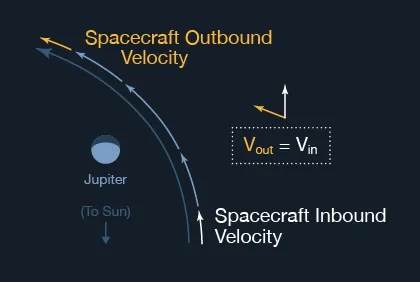
V(out)=V(in) relative to the planet, but to that you add the orbital speed of the planet
1
1
u/Mrs_Hersheys May 27 '26
this is the worst way to explain it I think
literally just imaginging it as some whacky ass arbitary slingshot worked way better for me
1
u/Secret-Shape-4404 May 27 '26
What's the limit? By this simplification, can't the ball reach the speed of light by just ping ponging between trains? How fast can a craft actually get with just the help of properly planned gravity assists?
1
u/Tigrium May 27 '26
I feel like Gravity Assists are misnomers. It implies the gravity of the object is the central cause of the assistance, while in reality it is the orbital velocity around the central orbital body (Sun for Planetary and Planets for Lunar).
1
1
u/Sharkytrs May 29 '26
struggling to wrap my head around this one.
why does the trains momentum get added twice?
from my understanding the ball should bounce off at 80mph
1
0
u/TraditionalTension95 Exploring Jool's Moons May 26 '26
Should I launch my rocket from the surface towards the planet's orbit?
1
u/3PoundsOfFlax May 26 '26
What surface? Kerbin? No, that would take a ludicrous amount of delta V which will then be doubled to slow down at your destination.
1
u/TraditionalTension95 Exploring Jool's Moons May 26 '26
To replicate the image, I must launch my rocket towards the planet so that it ricochets and flies away.
505
u/Worth-Wonder-7386 May 26 '26 edited May 26 '26
For those interested in the math it all comes down to reference frames.
In the reference frame of the train, the ball is moving towards the train at 80 mph when being thrown (50 mph from the train and 30 from the throw).
Assuming a perfectly elastic collision it will leave the train at a speed of 80 mph as seen from the train as well, but to the person on the ground you need to add the speed of the train to end up with 130 mph.
This video is also great at explaining this: https://www.youtube.com/watch?v=1baBzd1XPkU