r/artificial • u/theindependentonline • 17h ago
News All AI is ‘compromised’ and has fewer rules than milk, Microsoft bosses say
0
Upvotes
r/artificial • u/theindependentonline • 17h ago
r/artificial • u/cen6wkf • 20h ago
TL;DR: He had the "we're fucked" call with Matt, then checked how the data is actually captioned — and it doesn't hold up.
He built owned dataset with LiDAR, Unreal and volume stages, no peers' work trained on.
Do you remember that introductory banter between Q and James Bond – played by Ben Whishaw, and Daniel Craig, respectively, in Skyfall, 2012 – at the National Gallery, London?
Q: Well, I'll hazard I can do more damage on my laptop sitting in my pajamas before my first cup of Earl Grey than you can do in a year in the field.
Bond: Oh, so why do you need me?
Q: Every now and then a trigger has to be pulled.
Bond: Or not pulled. It's hard to know which in your pajamas.
That’s the last layer of judgement, right there.
In another scene back at the MI6 HQ, Whitehall in Spectre (2015), Q injected the “Smart Blood” nano-machines into 007’s blood stream for tracking, after Bond's unauthorized Mexico mission.
Q: Well it's lovely to see you, 007... the Smart Blood program is obviously still in its developmental phase. So we may experience the odd drop in coverage during the first 24 hours...
[Bond coldly glares at Q]
Q: …48 hours after administration, but after that it should work perfectly.
Later…
Bond: Could you do one more thing for me?
Q: And that would be?
Bond: Make me disappear.
The person who built the tracker can also be persuaded to create a blind spot — you own the workflow and you set the terms.
Just like what Affleck is building.
However - there’s absolutely no way in life we can “build a workflow” to get us into heaven with our “datasets” or merits. But God created a huge “blind spot” for us, through the blood of the lamb.
“For God so loved the world that He gave His only begotten Son, that whoever believes in Him should not perish but have everlasting life.”
r/artificial • u/kvis_mech • 10h ago
I am father of 2 kids and SAP Consultant. I use AI for research and some photo etc stuff nothing really life changing, it helps in my work a lot, it gets done fast and better, in general my efficiency increased.
But kind of every day comes new model, agent or something else and I don't know why I need that and what I can do with it. Feeling something like every year new iPhone upgrade which is not really necessary.
And all the work I do, gets done by free versions, so why you pay for those additional things? For what do you use it ? I don't know what more I can do with all these?
r/artificial • u/northward_42 • 20h ago
OpenAI didn't remove anything from mathematics, they only added. At worse it's just slop, so what.
"Now we have to review all this slop." No, just ignore it if you don't want to deal with.
"They solved my favorite puzzle which has no application. The journey was the point of it." So don't look at the solution!
"The future generations will not be motivated to go into math's if everything is solved." So you'd stop progress for that?
"The solutions are cryptic and we didn't gain any new understanding or new maths." Well then the problems weren't fully solved and there's still plenty to try to figure out.
r/artificial • u/rayanpal_ • 2h ago
r/artificial • u/pman6 • 5h ago
I've been casually looking at what a clusterfuck of a situation china is in lately with their economy, and I can't help thinking that very important lessons can be learned from china's mistakes.
I was curious how much of current ai buildout is actually being used, since it feels like they are just overbuilding at any cost.
Google search says this...
Massive Overbuilding / Ahead of Curve:

According to analysis from Bain & Company, existing consumer and enterprise AI services generate a fraction of what is being invested (estimated around $1.8 trillion out of a required $6 trillion in annual/cumulative value by 2031).

Industry reports note that AI infrastructure is being deployed significantly ahead of the demand curve, relying heavily on speculative future use cases in robotics, autonomous machines, and specialized enterprise applications
China built a massive rail network, putting train stations everywhere.
What ended up happening is the entire country's rail network operates at a massive financial loss. Many train stations don't even have the ridership to justify putting a station there, so they abandoned them.
High speed train is relatively expensive as they raise prices, so citizens opt to ride the cheaper slow train.
.
I just can't help seeing the analogy of overbuilding and eventual under-utilization.
r/artificial • u/lu-lw • 17h ago
I'm looking for honest, realistic advice from people working in AI research, mathematics, physics, or related technical fields.
I'm a prospective university student planning to study abroad, and my long-term goal is to become a physicist and researcher I'm particularly interested in fundamental physics, especially the connection between quantum mechanics and general relativity.
However, my circumstances mean that I probably won't start university for another two years. During that time, I plan to rebuild my mathematical foundations, learn the necessary skills, work toward financial independence through online work, and apply for scholarships abroad.
The problem is that recent AI developments, especially in advanced mathematics and scientific reasoning, have seriously shaken my confidence in this plan.
If I start my bachelor's degree in approximately two years, I'll need several more years to complete it. If I eventually pursue a master's or PhD, we're looking at roughly 8–10 years before I reach that stage of my career.
By then, AI could be vastly more capable than it is today. We might have systems that independently solve difficult mathematical problems, develop scientific theories, and make discoveries that would otherwise take human researchers years or decades.
I understand that these are uncertain predictions, not established facts. But I don't think it's reasonable to ignore this possibility when making a decision that will shape my entire adult life.
My concern isn't just whether humans will still be able to do physics. It's also whether pursuing physics will remain a sensible career and financial decision.
I genuinely want to do research, but I also need to earn a good living. I want financial independence, the ability to afford healthcare and housing, and the possibility of supporting a family in the future. I don't want to spend a decade developing highly specialized skills only to discover that opportunities have become extremely scarce or that the economic value of those skills has changed dramatically.
I also realize that being exceptionally intelligent or working in a difficult field doesn't automatically guarantee a high income. That's precisely why I'm trying to understand the situation before committing to this path.
I'd appreciate your perspective on a few questions:
How likely do you think it is that AI will fundamentally transform or largely automate scientific research within the next 8–10 years? What evidence supports your view?
Could increasingly capable AI systems make human physicists less employable, even if they dramatically increase scientific productivity?
If you were starting university today and wanted both a meaningful research career and strong financial prospects, would you still choose physics? Would you choose theoretical physics, applied physics, computational physics, AI, or something else?
Which skills are most likely to remain economically valuable if AI becomes substantially better at mathematics, programming, and scientific reasoning?
Is there a realistic path that combines fundamental physics research with opportunities in industry and well-paid technical work, rather than relying entirely on an academic career?
Am I overestimating how quickly AI could advance, or is this a risk that prospective students genuinely need to plan around?
I'm not asking anyone to predict the future with certainty, and I'm not looking for empty reassurance that everything will work out.
I'd particularly value responses from people who work directly in AI development, AI research, physics, or scientific computing, and who can distinguish their firsthand experience from speculation.
If you were in my position, with limited financial resources and the next 8–10 years of your life at stake, how would you approach this decision?
Thank you for taking the time to read this. I genuinely want to make an informed decision rather than choose a career based on either fear or blind optimism.
r/artificial • u/esporx • 16h ago
r/artificial • u/lulzxdxdxd • 19h ago
r/artificial • u/Full_Piano_3448 • 17h ago
Data from Register.si and threat intelligence firm Netcraft shows a major surge in Slovenian national domain registrations (.si) following the recent U.S. Executive Order directing federal agencies to adopt the term "Super Intelligence" (SI) instead of "Artificial Intelligence" (AI).
Key Highlights:
.ai boom, with over half of newly registered domains listed for resale shortly after registration.Sources: Register.si monthly stats / Netcraft Threat Intelligence.
Do you think .si will follow a similar trajectory to .ai, or is this purely short-term domain speculation?
r/artificial • u/lulzxdxdxd • 13h ago
r/artificial • u/lulzxdxdxd • 17h ago
r/artificial • u/ThereWas • 8h ago
r/artificial • u/lulzxdxdxd • 10h ago
r/artificial • u/lulzxdxdxd • 18h ago
r/artificial • u/lulzxdxdxd • 9h ago
r/artificial • u/Ok_Calligrapher_3034 • 16h ago
Hey everyone,
Looking at how rapidly AI development is evolving—especially with workflows moving towards autonomous monitoring, multi-agent orchestration, and managing entire backlogs—it feels like we are reaching a major turning point.
We are seeing a massive shift from simple text-prompt chatbots to actual AI agents running complex tasks independently. However, I wanted to open a discussion with this community on a few core questions:
* Where do you draw the line between helpful automation and risky over-reliance on autonomous agents?
* What is the biggest bottleneck holding AI agents back from truly replacing traditional workflows in production environments right now?
* For those building or integrating these systems, what has been your biggest surprise regarding agent reliability?
Let us hear your thoughts, experiences, and predictions in the comments below!
r/artificial • u/Alchemistwiza • 3h ago
Microsoft’s October 12 Maia announcement distinguishes Maia 200 production workloads from Maia 300 deployments planned for 2027. The interesting question for a useful comparison is what stays fixed.
More tokens per unit of power could matter, but I’d want to know whether the models, output quality, context lengths and latency targets are comparable. A fast answer that needs several corrections changes the cost of the finished task.
My preferred comparison would report energy per accepted result as well as throughput, with an explicit workload and quality check. Which tradeoff would matter most for your use case - latency, sustained capacity, or the cost of getting a result you can actually use?
AI-assisted discussion. This is a comparison proposal, not an independent hardware benchmark.
r/artificial • u/sourdub • 11h ago
r/artificial • u/Dry-Tip-2082 • 9h ago
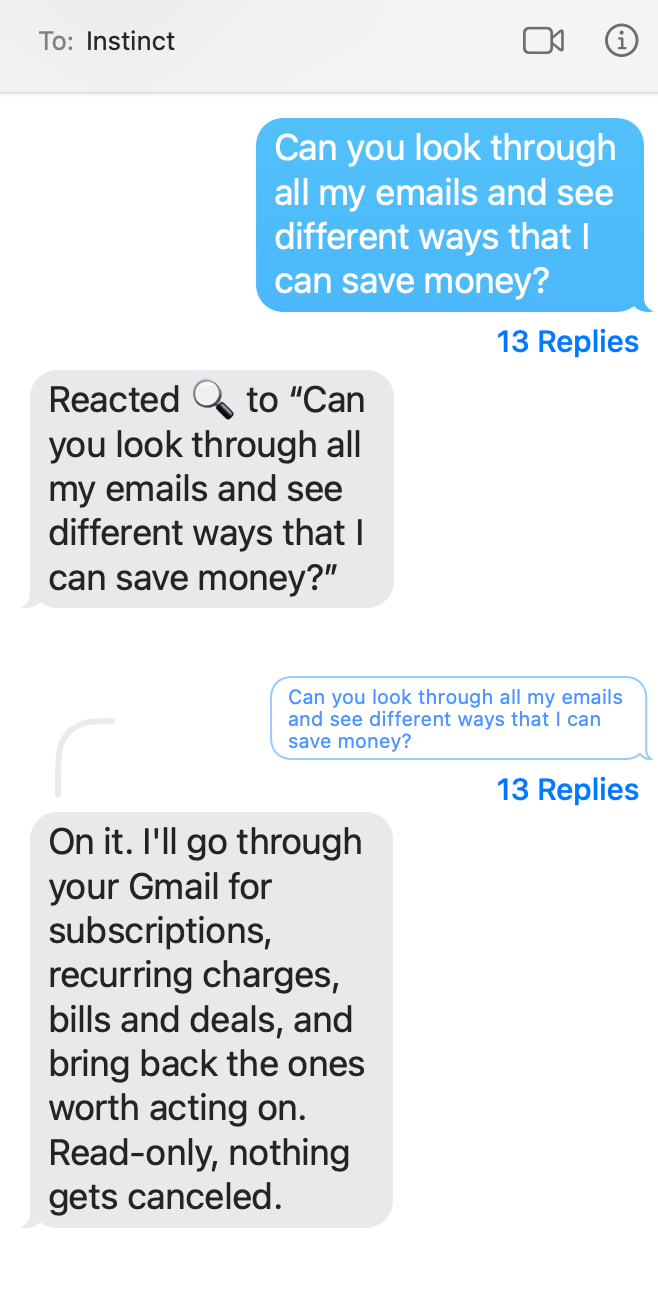
Below is my preliminary review of Instinct
Does it live up to the hype?
Short answer: Yeah, kinda.
Big picture, imagine an online secretary that does your bidding for you whenever you want. You just talk to it through imessage and it does tasks for you that you are too lazy to do on your own. The more access you give it over your information, —e.g., digital wallet, gmail, calendar— the larger the task it could accomplish for you.
The way I got involved with it is through my brother. He’s super involved in the AI / tech world and got access, He then gave me an invite —it’s an invite only app, but cost zero dollars if you got an invite. For the past week I’ve been playing around with it to see if it is practically helpful to me.
First, I love that everything is in imessage. As you can see from my screenshot below, it was able to go through my gmail and identify all my recurring subs. It then asked which ones I wanted deleted. With the okay, it went and stopped each of the subscriptions.
okay, so now we’ve established one tangible use case, it can save you money by canceling subscriptions. It could also cancel flights and book you trips based on very specific filters —e.g., you want a five star hotel? You want the cheapest options? Though, to be fair, it does have challenges with certain tasks depending on the website and apps that you ask it to go into. For example, I asked it to go into my lyft app and delete my annual subscription, which it had trouble doing.
The other obvious use case I’ve found helpful is that it can add things to my calendar. It could also answer emails for me. It doesn’t just give me the draft, it actually goes in and send the email after getting my approval. Naturally, this saves a ton of time.
To be honest, I’ve actually been running out of things to ask it. Now, I have set up open claw on my own server in the past, but this is far better than anything I hosted. It is also completely free (for now). I hear that Muse (AI-agent made by Meta) is very good as well, but I haven’t tried it out —the main reason being that I like IMessage too much. For Muse you need to use What’s App to connect to the agent.
I find myself having that overwhelming knot in my stomach thinking about how fast everything is moving with AI, but alongside some excitement for the kind of the future that would be possible using these tools for the right ends (e.g., scientific discovery, improving access to education, not wasting time with rote tasks).
Wonder what other folks think about Instinct or Muse or other ai agents I've never been exposed to. thanks!
r/artificial • u/lulzxdxdxd • 15h ago
r/artificial • u/lulzxdxdxd • 3h ago
r/artificial • u/fasildar55 • 10h ago